


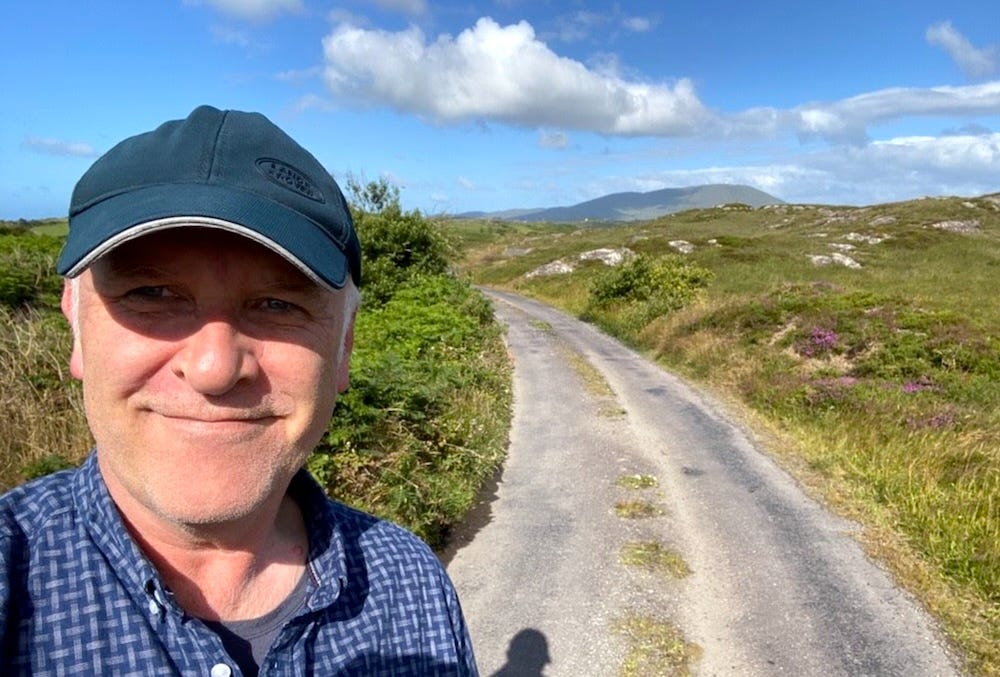
Travel west along the rolling hills of County Cork, through colourful villages and down the boreens that wind toward the sea through patches of gorse and turfed walls older than memory, and you'll find Ballydehob, recently crowned the coolest town in Ireland by an Irish national newspaper. It's a bold claim for a place you could walk through in ten minutes, but spend any time there and you'll understand why. This is where Ireland keeps its best-kept secrets, tucked away in corners where tourists rarely venture but magic happens daily.
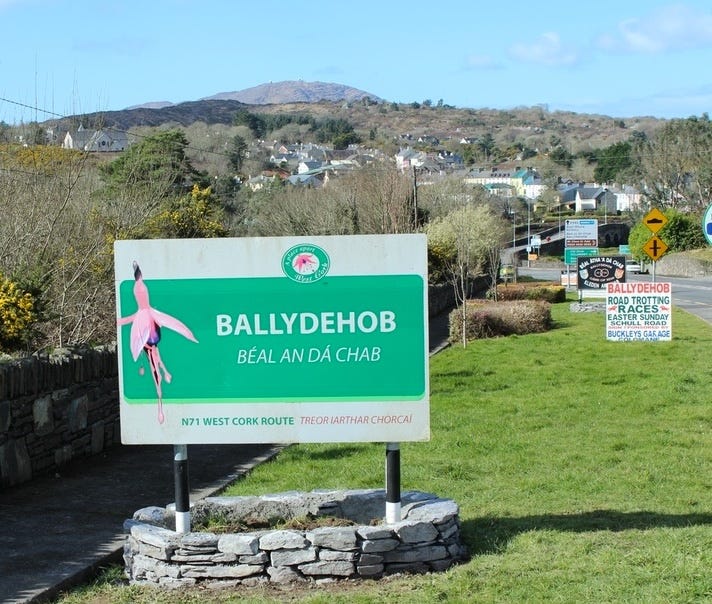
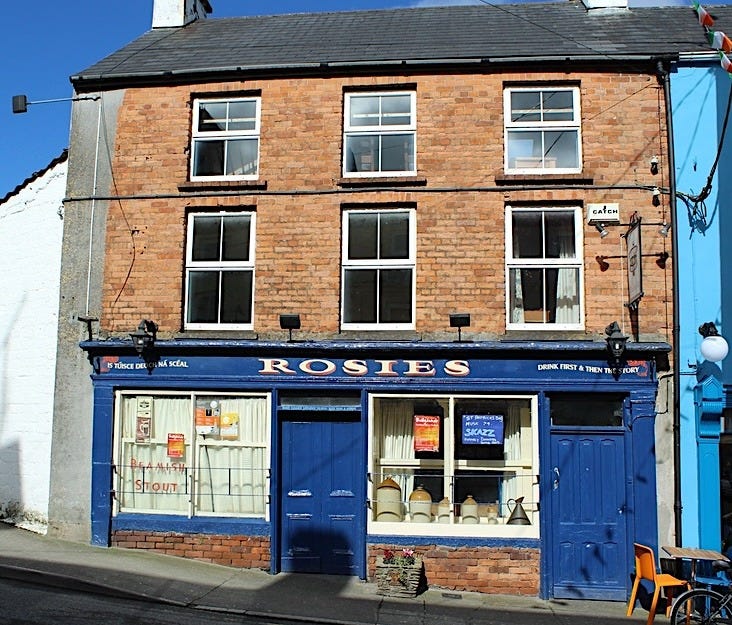
Ballydehob is where my father comes from. I have been going there as long as I can remember, and long before that, carried in arms before I could walk, pushed in prams before I could talk. At the centre of this small universe sits Rosie's pub, run by Noel Camier, with an art studio perched upstairs like a creative crown on an already perfect head.
On this particular Saturday afternoon, I step through Rosie's door for what I tell myself will be a "quick cider" with a local cousin. The familiar smell of turf fire and old wood greets us, but something else is stirring - the unmistakable energy of musicians setting up for what locals call a "session." Instruments emerge from cases like old friends greeting each other, and I realise my quick drink has just become something far more precious.
Then, like a scene from an Irish fairy tale, in walks Jackie "Joker" Daly, a man who single-handedly made the button accordion acceptable again in Irish traditional music by rescuing it from the dusty corners to where purists had banished it. Jackie is hardly through the door when he's telling jokes to anyone who will listen, his laughter as musical as any tune he'll play. Behind him comes Matt Cranitch, fiddle maestro, carrying his instrument like a holy relic.
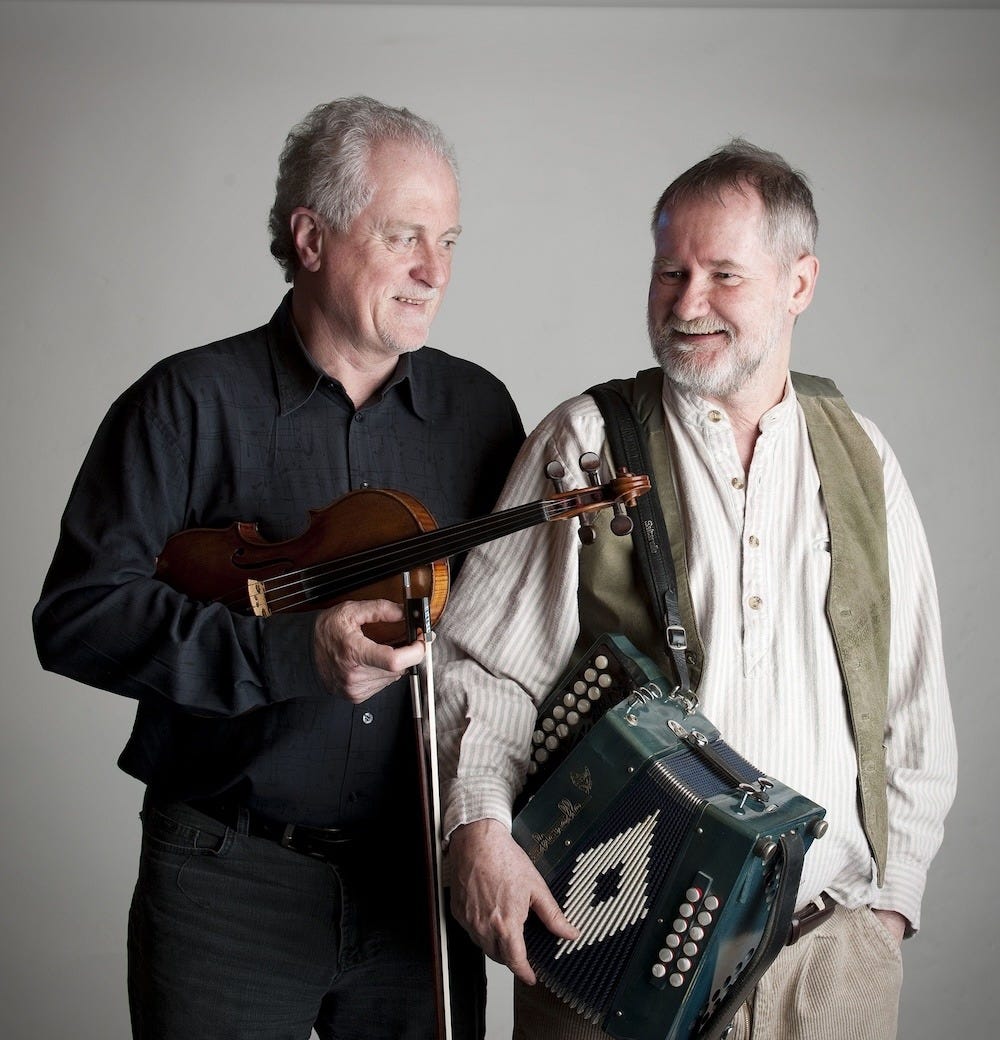
The gig is billed simply as "Matt Cranitch, Jackie Daly and Friends," but in this understated Irish way lies something profound. These are giants of traditional music, legends who could command concert halls and festival stages anywhere in the world. Yet here they are, setting up in the corner of a village pub where the price of admission is whatever you're drinking.
The accompanying musical friends, local players and visiting musicians drawn by the gravitational pull of such talent, all have a pint or two settling on the table in front of them. But I notice something telling: the maestros stick with water. They treat this music with the reverence of priests approaching an altar. This isn't background entertainment; this is cultural preservation happening in real time.
At exactly 3:00 PM - for Irish musicians may be many things, but tardy they are not when music is concerned - a fiddle sets time on an old Sliabh Luachra tune, and suddenly we are transported. The pub falls into that particular Irish silence that happens when music takes over, when conversations pause mid-sentence and even the glasses seem to listen.
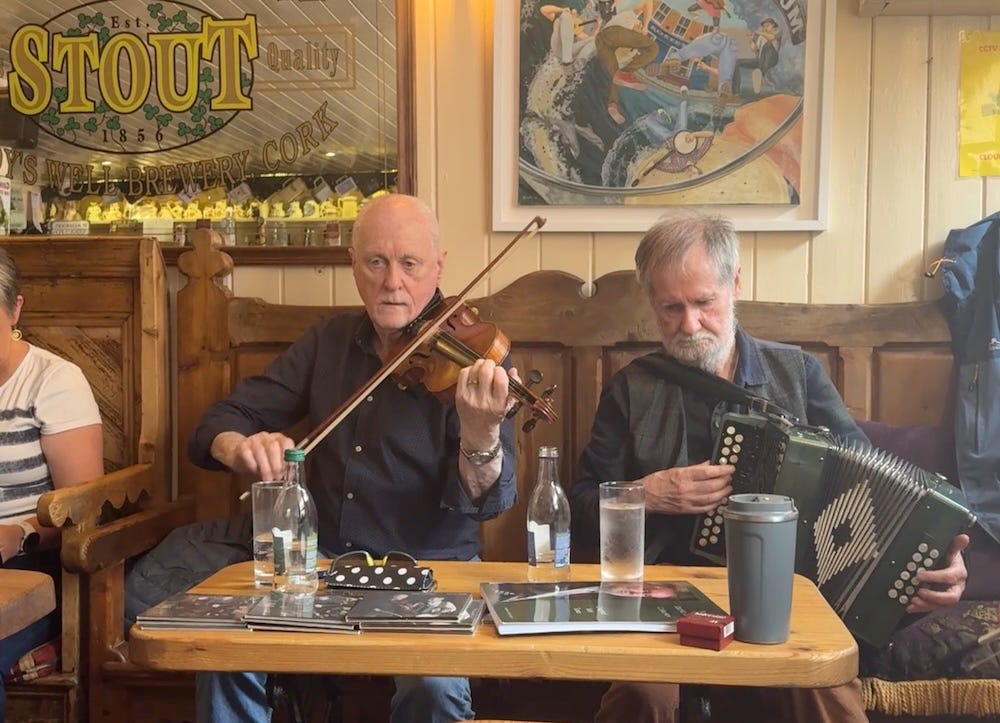
Key changes are nodded in by Jackie with the subtle communication of musicians who speak the same ancient language. The players proceed in wonderful lockstep through the tune, each ornament and variation perfectly placed, building something together that none could create alone. The music flows like water finding its level, natural and inevitable.
What strikes me most is not just the extraordinary calibre of the playing, but the setting itself. Here, in this ordinary pub in this small Cork town, we are witnessing artistry that would command standing ovations in Carnegie Hall. Yet it unfolds with the casual intimacy of neighbours sharing stories over the fire. Children wander between tables, dogs settle at their owners' feet, and conversations resume in whispered tones during the brief pauses between sets.
This is the Irish pub at its most essential - not the plastic shamrock stereotype exported around the world, but the real thing: a community gathering place where culture lives and breathes. The traditional Irish pub has always been more than just a place to drink; it's the village parliament, the social club, the theatre, and the concert hall all rolled into one. It's where news is shared, stories are told, and music - always music - provides the soundtrack to Irish life.
As the afternoon stretches toward evening and the light through Rosie's windows grows golden, I'm reminded why places like this matter. In our increasingly digital world, where music is often consumed alone through headphones, the traditional Irish music session represents something almost revolutionary: live, communal, participatory culture happening in real time.
For travellers to Ireland, seeking out these musical pubs isn't just recommended, it's essential. Forget the organised "Irish nights" and tourist-focused entertainment. Instead, ask locals where the sessions happen. Learn the difference between a pub with traditional music and a traditional music pub. The former puts on shows; the latter lives and breathes the tradition.
The beauty of these traditional Pub encounters is their unpredictability. You cannot book them, cannot guarantee them, cannot manufacture them. They exist in the spaces between the scheduled and the commercial, in the realm where art meets life meets community. They happen because music in Ireland is not a performance but a conversation, not a show but a way of being.
As I finally leave Rosie's, my "quick drink" having stretched into an hour or two of musical bliss, I carry with me not just the memory of extraordinary music, but the deeper satisfaction of having witnessed something real and stubbornly authentic.
So when you find yourself in Ireland, follow the sound of the fiddle down narrow streets and into welcoming pubs. Pull up a chair, order a pint, and prepare to be amazed.
You might just discover that the coolest town in Ireland - or the warmest welcome, the finest music, the most genuine craic - is wherever you happen to be when the music starts.
After all, in Ireland, you're never more than a tune away from magic.