


The morning mist remains across the land as we turn off the main road, leaving behind the rush hour of contemporary Ireland. Following narrow country roads that twist like Celtic knotwork across the Louth countryside, we feel ourselves slipping backward through time with each passing mile. Our journey to Monasterboice is both a physical journey and a crossing between worlds.
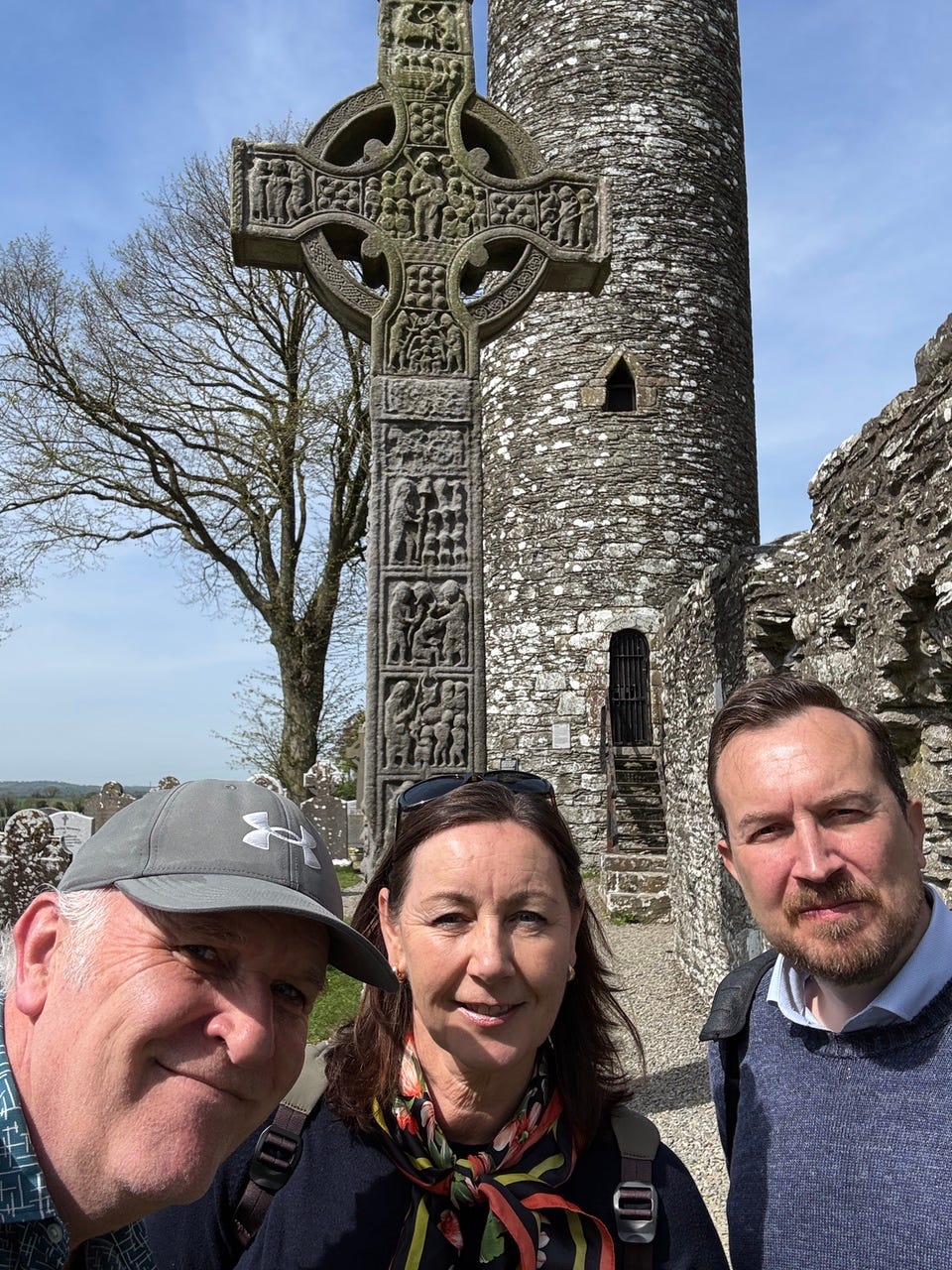
As we pull into the modest car park, there's little to hint at the treasure that awaits. A simple stone wall, an old iron gate – mundane guardians of the extraordinary. But as we walk through that gate, the modern world falls away completely. Before us stands a landscape from the Celtic Christian imagination – ancient crosses reaching skyward like stone prayers, a weather-worn round tower standing over sacred ground, all embraced by a carpet of tombstones resting in the spring grass under the shelter of venerable trees.
The silence here has texture. It's not the absence of sound, but rather the presence of something older than noise – a quiet that seems to have gathered here since Saint Buite first walked this ground in the twilight of the 5th century. A blackbird's song punctuates the silence like illuminated letters on a manuscript page.
I realise I'm holding back my breath, as if afraid to disturb the delicate balance between now and then. When I finally exhale, it feels like a first breath in this older, slower world.
Muiredach's Cross: A Stone To Tell Stories
It draws us like a magnet – Muiredach's Cross – the finest in all Ireland. As we approach this 5.5-meter monolith, what first appeared as mere texture resolves into stories. A millennium of Irish weather has weathered but not erased these stone tales.
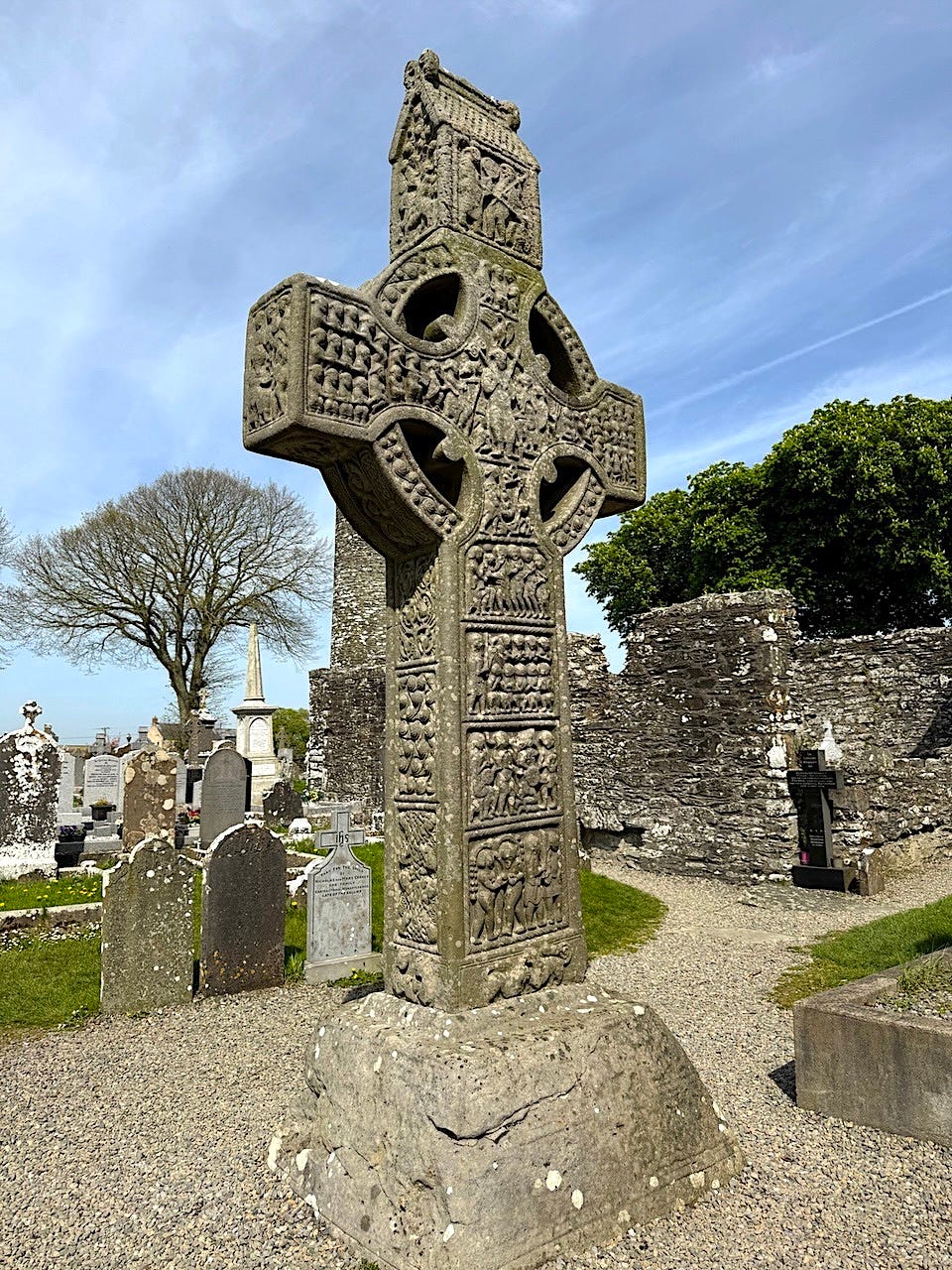
The sandstone surface displays biblical narratives and native mysteries, interpreted through a distinctly Hibernian lens. Here, Christ wears no crown of thorns nor expression of agony – this is not the suffering Jesus of later medieval art but a triumphant Christ of Celtic Christianity, standing before the cross rather than hanging upon it, embodying victory instead of torture.
I circle the cross slowly, letting my fingers hover an inch from its surface. The panels unfold like an ancient picture book: Adam and Eve beside the tree, Cain raising his cleaver against Abel, David confronting Goliath, Moses striking water from rock. Stories of temptation, betrayal, courage, and miracle – the eternal human drama captured in sandstone.
On the cross's base, barely legible, the ancient inscription asks for "a prayer for Muiredach, for whom this cross was made." A thousand years later, I now find myself silently offering that very prayer – for this long-dead abbot who gave us such beauty, for the nameless artisans whose hands shaped these stones, for all those seeking meaning across the centuries.
Who was the master carver whose vision transformed rough sandstone into this theological library? Did he know his work would stand for a millennium and more, still speaking to souls far beyond his death?
The Round Tower: Reaching for Heaven
Beyond the cross, our eyes are naturally drawn upward to the round tower, its weathered stone rising like a finger pointing toward heaven. Though missing its conical cap – lost to fire centuries ago – it still commands attention.
Standing in its shadow, I can't help but think of the countless prayers that have spiraled up its staircase, the manuscripts and treasures it once protected, and the monks who climbed its interior steps. I think of the towers in my own life – aspirations and dreams that reach beyond my grasp but orient my journey nonetheless.
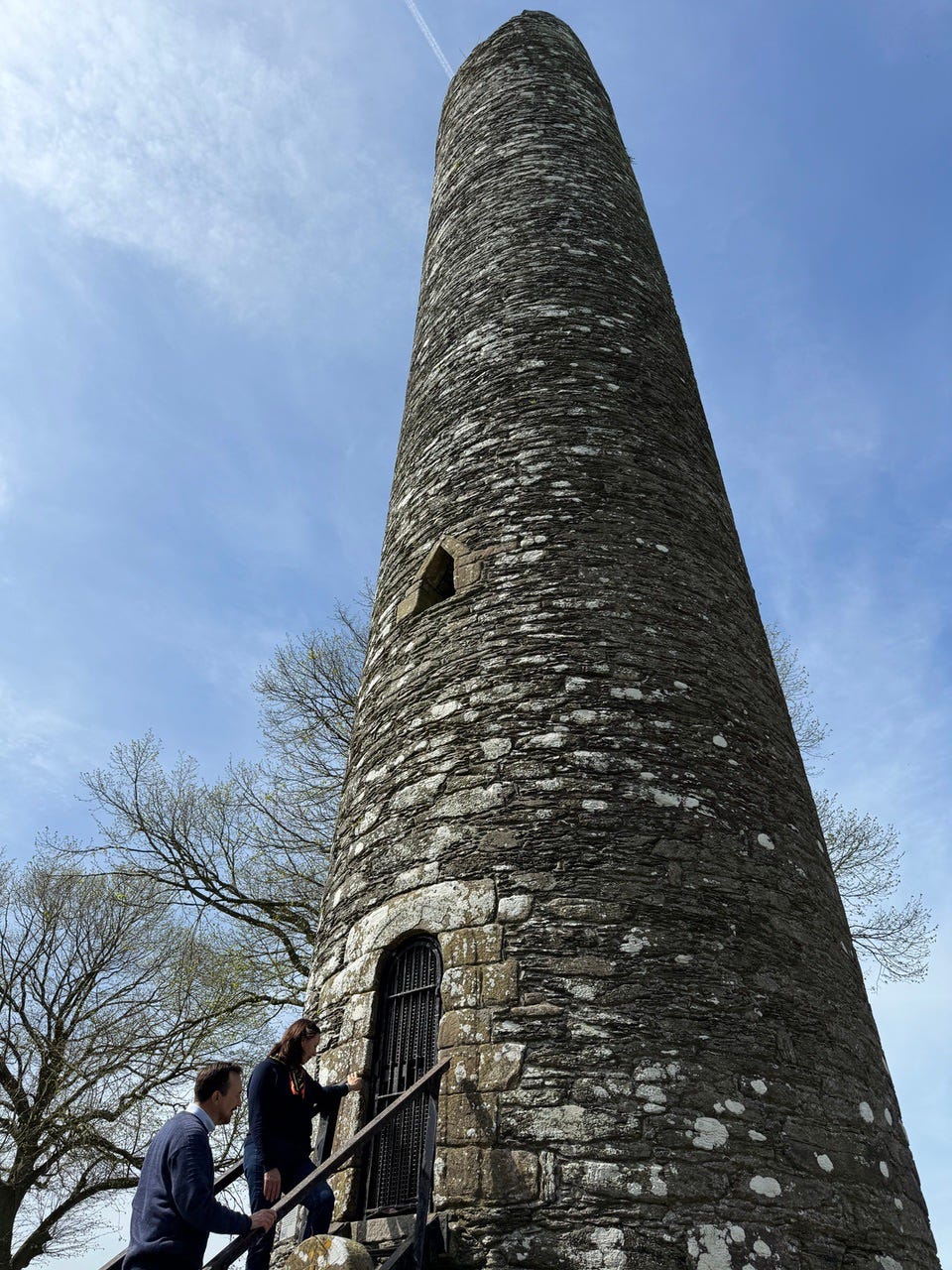
How many souls sought refuge here when Norse raiders appeared on the horizon? The tower reminds me of those moments in my own life when I needed to retreat, to find higher ground, to gain perspective when surrounded by chaos.
A raven circles the tower's top, its black wings cutting sharp relief against the blue sky – messenger between worlds in Celtic lore, harbinger of the divine in early Christian symbolism. The boundaries between these traditions seem as permeable as the morning mist.
Reflecting Heaven on Earth: The Sundial
Nearby, easily overlooked amid such grandeur, the ancient sundial rests. Its weathered face has marked sacred hours since monks gathered here for “terce”, “sext”, and “none” – punctuating their productivity with prayer. The shadow knows nothing of minutes or seconds – only the broader sweep of sun across heaven, the rhythmic pulse of seasons, a patient turning of years into centuries.
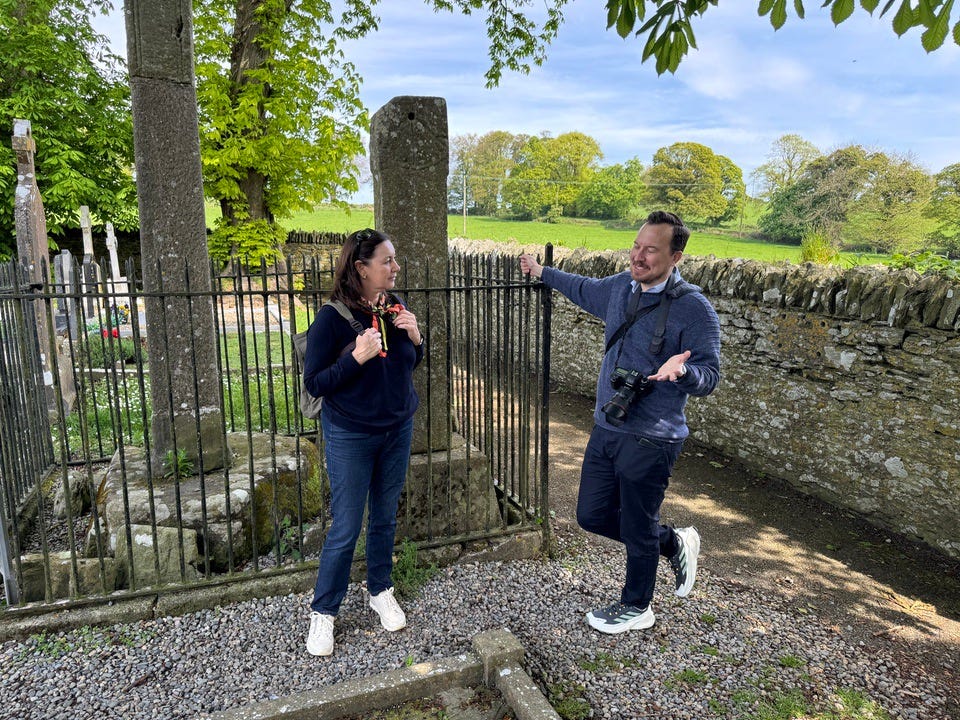
I check my wristwatch reflexively, then laugh at the absurdity of modern timekeeping in this place. Here is an invitation to measure life differently – not by deadlines and appointments, but by the moments of wonder provided by nature, by connections across time, by the rising and setting of celestial bodies.
When was the last time we lived by the sun's rhythms rather than the clock's tyranny? Something in me resolves to rediscover a more natural timekeeping, to find spaces in my days that stretch rather than constrict.
Echoes and Whispers of A Viking Connection
As we wander among the grave slabs, an interpretive sign catches my eye, describing the curious relationship between Monasterboice and the Viking settlement at nearby Annagassan. While other great monasteries fell to Norse raiders, this place somehow remained unscathed.
We study the panels on Muiredach's Cross with renewed attention, noting the figures with distinctive Viking moustaches wearing ecclesiastical robes. Could this truly depict the extraordinary story of Norse warriors becoming Christian monks? Of former enemies finding common ground in sacred space?
The thought resonates with my own struggles to reconcile seemingly irreconcilable parts of my life – the spiritual and material, ambition and contentment, roots and wings. Perhaps the ancient wisdom of this place lies not in purity but in integration, in the Celtic Christian genius for absorbing rather than opposing, for finding the sacred in the profane.
In a world increasingly divided by rigid boundaries – political, religious, cultural – the ancient stone suggests another way. I make a mental note to remember this: transformation often lives within the places of the deepest divisions.
The Graveyard: A Thin Place Between Worlds
The graveyard surrounding these monuments tells its own stories. Headstones from centuries past lean at impossible angles, inscriptions softened by time and lichen to offer only suggestions of the names they once remembered. Others, more recent, stand straight and legible – the newest barely months old, lain with fresh flowers – tended to by the living.
In Celtic tradition, graveyards are "thin places" where the veil between worlds grows transparent. Standing here among the dead of forty generations, I sense the truth in this. The boundary between past and present, material and spiritual, memory and reality – all seem permeable.
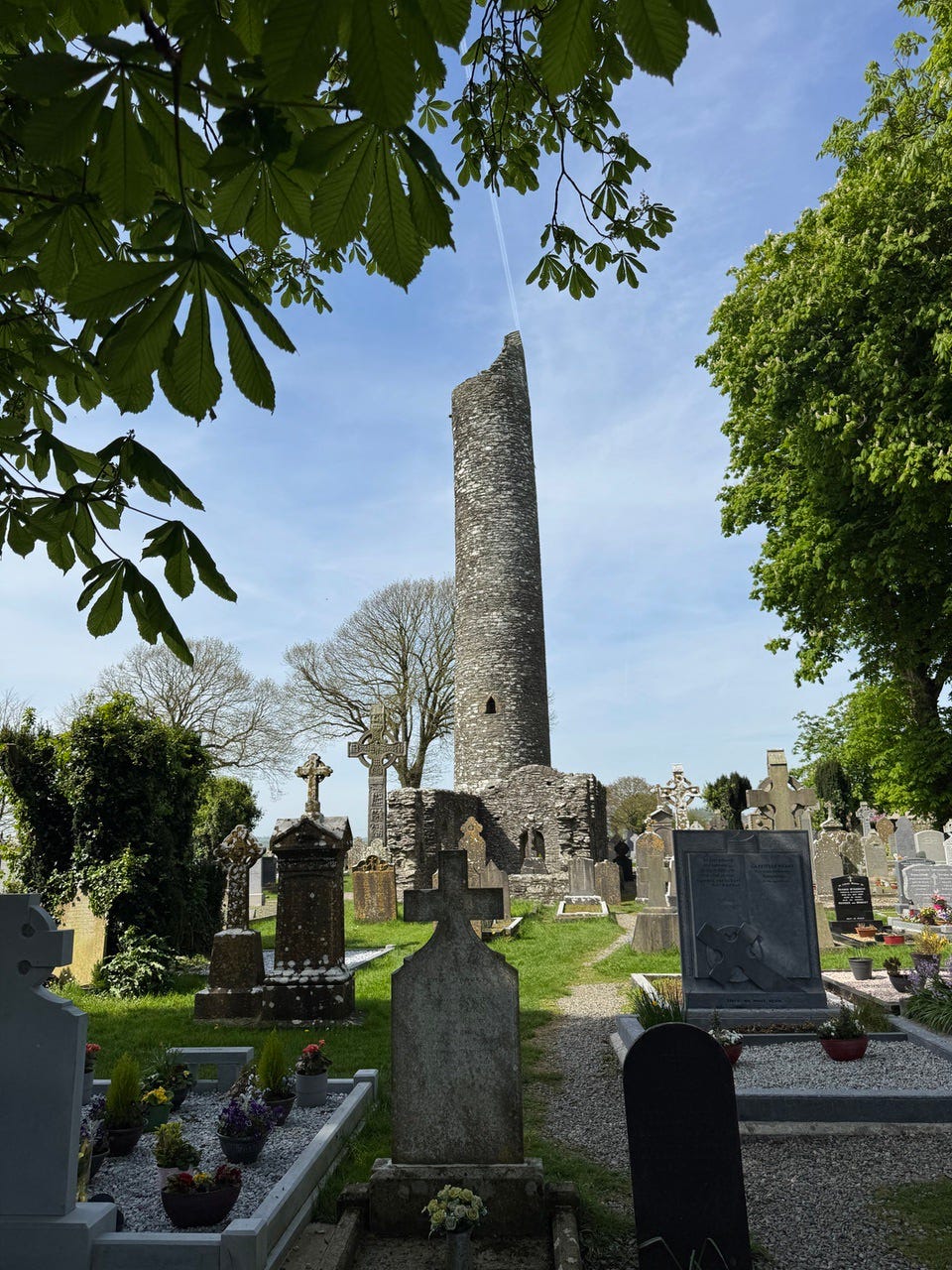
I think of those I've loved and lost, ancestors whom I have never known, how their absence has shaped me as surely as any presence. Here in this ancient place of remembrance, they feel closer somehow – not through supernatural visitation but through the simple recognition that we all share the same journey, separated only by timing. We are connected by invisible threads across time, each of our lives a brief character in a much longer story.
Carrying the Sacred Forward
As the noon sun rises and shortens the shadows across the grass, we know it's time to leave. The modern world awaits with its emails and obligations, its noise and haste.
But as we walk back toward the gate, I notice I'm moving differently – not just slower, but more deliberately, more attentively. An ancient rhythm from this place has infiltrated my body, altered my breathing from the time of entry. I carry something invisible yet substantial away with me.
Perhaps it's perspective – the humbling recognition of my small place in time's vast expanse. Perhaps it's connection – to those ancient monks, to the artisans who carved eternal stories in stone, to my own ancestors who might have knelt on this very ground. Perhaps it's simply permission to live more fully in each moment, to measure life by meaning rather than by minutes.
Our car rejoins the flow of modern traffic, and Monasterboice recedes in the rearview mirror. But unlike ordinary tourist sites that fade with distance, this place seems to grow more present within me. The crosses have etched a place on my inner landscape; the round tower now stands in my mental geography.
I realise that the true journey of Monasterboice isn't the physical visit but the internal pilgrimage it provokes – a journey to continue long after we've left, calling to find the sacred within the ordinary, to recognize the eternal stories playing out in our own brief chapters, to stand at the intersection of heaven and earth in our everyday lives.
And isn't this the deepest magic of ancient sacred sites? Not that they transport us to the past, but that they transform our experience of the present. The stones of Monasterboice have whispered some secrets to us – not answers, but questions to accompany us homeward, questions that might take a lifetime to fully explore.
In the Celtic tradition, a journey's end is merely the beginning of another journey. As twilight gathers over the Louth countryside that evening, we carry the light of Monasterboice forward – each a pilgrim illuminated by these ancient stones, each a character in their unending tale.
⟡ Step into your own unhurried day
The monks once told their hours by the slow crawl of shadow across a weather-worn stone. Wherever sunlight might find you today, let your own hand become the dial:
lift it, palm open, in a place where a quiet shadow falls; watch the shadow drift for the length of a few unhurried breaths;
notice one moment in your daily rhythm that longs to stretch the way that shadow stretches.
What changes when time is measured by light and hush instead of digits and alerts?
Capture the thought in a line of your journal, or share a photo of your “hand-sundial” if you feel moved; I’d love to see how the shadows travel where you are.